ISI Quartile Rankings Explained
Publishing in ISI-indexed journals is one of the most important goals for researchers, PhD students, and academic professionals worldwide. However, not all ISI journals are equal in terms of quality, prestige, and acceptance difficulty. One of the most widely used systems for evaluating ISI journals is the Quartile Ranking system (Q1, Q2, Q3, Q4).
Understanding ISI quartiles is essential for choosing the right journal, improving acceptance chances, managing publication time and cost, and aligning your research with institutional or graduation requirements. In this guide, TadbirSaz explains ISI quartile rankings in a clear, practical, and researcher-focused way.
What Are ISI Quartiles?
ISI quartiles are a ranking system used in the Journal Citation Reports (JCR), published by Clarivate Analytics, to categorize journals indexed in the Web of Science (WoS) database.
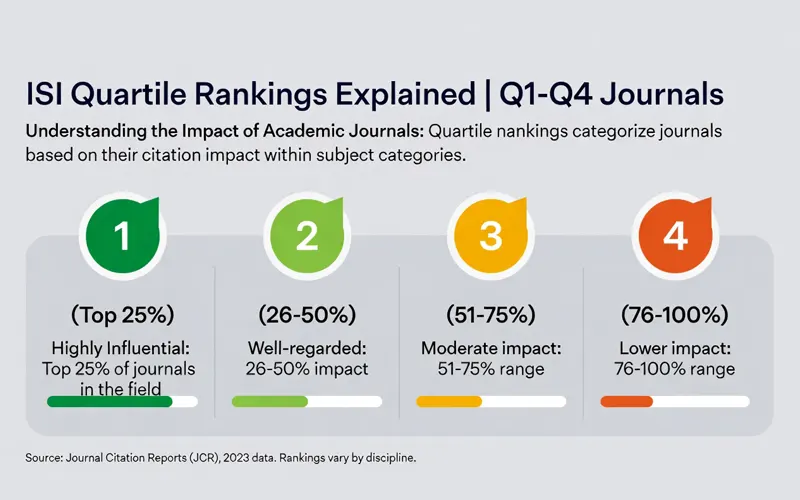
Each journal is ranked within its specific subject category based on performance indicators—primarily Impact Factor (IF). Journals are then divided into four equal groups:
- Q1 – Top 25% of journals in a category
- Q2 – Journals ranked between 25% and 50%
- Q3 – Journals ranked between 50% and 75%
- Q4 – Bottom 25% of journals in the category
Key Points About ISI Quartiles
- Quartiles are category-specific (a journal can be Q1 in one field and Q2 in another)
- Quartiles are updated annually
- They are widely used by universities, funding bodies, and promotion committees
Difference Between Q1, Q2, Q3, and Q4 Journals
Understanding the differences between quartiles helps researchers make strategic publication decisions.
Q1 Journals
- Highest prestige and visibility
- Strong international readership
- Very competitive peer review
- Long review cycles
- High rejection rates
Q2 Journals
- Strong academic credibility
- Moderate to high impact
- More reasonable acceptance probability than Q1
- Suitable for solid, well-structured research
Q3 Journals
- Acceptable scientific standards
- Often field-specific or regional
- Shorter review times
- Higher acceptance rates
Q4 Journals
- Entry-level ISI journals
- Suitable for early-career researchers
- Faster review and publication
- Lower impact factor
How Quartiles Affect Acceptance
Quartile ranking directly influences editorial expectations, reviewer strictness, and acceptance probability.
Main Factors Influenced by Quartile:
- Scientific novelty required
- Methodological rigor
- English language quality
- Journal scope alignment
- Tolerance for minor weaknesses
At TadbirSaz, we help authors match their manuscript to the most realistic quartile, rather than blindly targeting Q1 journals and facing repeated rejections.
Q1 vs Q2 Journals
Many researchers struggle to choose between Q1 and Q2 journals.
| Factor | Q1 Journals | Q2 Journals |
|---|---|---|
| Prestige | Very high | High |
| Acceptance Rate | Very low | Moderate |
| Review Time | Long | Medium |
| Cost (APC) | Usually high | Moderate |
| Risk Level | High | Medium |
📌 Expert Tip:
For graduation, promotion, or funded projects, a strong Q2 publication often provides better cost–benefit balance than attempting multiple Q1 submissions.
Are Q4 ISI Journals Easier?
Yes—Q4 ISI journals are generally easier to publish in, but they are still indexed and legitimate.
Advantages of Q4 Journals:
- Faster acceptance
- Lower publication fees
- Suitable for applied or regional studies
- Good option for first ISI publication
Limitations:
- Lower impact factor
- Less international visibility
At TadbirSaz, Q4 journals are often recommended for:
- MSc or early PhD students
- Time-sensitive graduation requirements
- Applied research with limited novelty
Quartile vs Impact Factor
Although related, quartile ranking and impact factor are not the same.
Impact Factor (IF):
- A numerical value
- Measures average citations
- Absolute number
Quartile:
- Relative ranking within a category
- Depends on other journals in the same field
📌 A journal with IF = 2.5 may be Q1 in one field and Q2 in another.
How TadbirSaz Helps You Choose the Right Quartile
Choosing the wrong quartile is one of the main reasons for manuscript rejection. TadbirSaz provides professional journal selection services based on:
- Manuscript quality assessment
- Research novelty analysis
- Author publication goals
- Budget and timeline constraints
Our Quartile-Based Strategy Includes:
- Pre-submission scientific evaluation
- Matching your paper to suitable Q1–Q4 journals
- Estimating acceptance probability
- Optimizing manuscript structure and language
- Full submission and revision support
Guaranteed Publication: Myth or Managed Process?
While no ethical journal guarantees acceptance, TadbirSaz offers managed acceptance pathways, meaning:
- Journal selection with historical acceptance data
- Multi-stage editing and reviewer-response preparation
- Resubmission support if needed
- Clear refund or revision policies (based on contract)
This approach significantly increases success rates—especially for Q2–Q4 ISI journals.
Common Mistakes Researchers Make with Quartiles
- Targeting Q1 with weak methodology
- Ignoring journal scope despite high IF
- Confusing Scopus quartiles with ISI quartiles
- Underestimating language quality
- Choosing journals based only on speed
Avoiding these mistakes can save months of time and thousands of dollars.
Frequently Asked Questions (FAQ)
How long does ISI publication take by quartile?
Q1: 6–12 months
Q2: 4–8 months
Q3–Q4: 2–5 months
Do universities accept Q4 ISI journals?
Yes, depending on institutional policy.
Can one paper be submitted to multiple quartiles?
No. Submitting simultaneously violates ethics.
Is Q2 better than low-impact Q1?
Often yes, especially for acceptance probability.
Final Thoughts: Choose Smart, Publish Strategically
ISI quartile rankings are not just numbers—they are strategic tools. Understanding them allows you to publish faster, reduce rejection risk, and align your research with academic goals.
At TadbirSaz, we combine scientific expertise, ethical publishing standards, and strategic journal selection to help researchers publish confidently in ISI-indexed journals.
Get a free quartile evaluation today and start your publication journey with confidence.