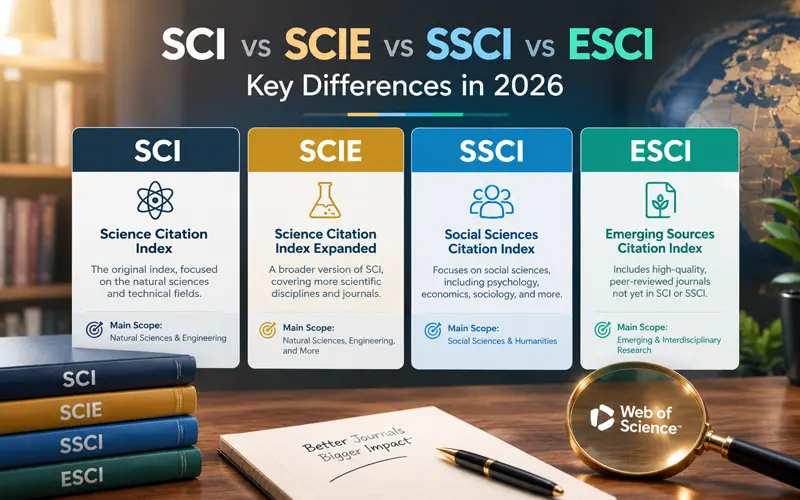
SCI, SCIE, SSCI, AHCI and ESCI: What Is the Difference?
When researchers search for a journal in which to publish their work, they frequently encounter five abbreviations: SCI, SCIE, SSCI, AHCI, and ESCI. These terms appear in university publication requirements, research evaluation systems, journal websites, and academic promotion guidelines.
Although they are often discussed together, they do not all have the same meaning. Some refer to established citation indexes covering specific disciplines, while others describe different levels of journal selection within the Web of Science Core Collection.
Understanding these differences is essential when selecting a publication venue. A journal may be indexed in Web of Science but not belong to the specific collection required by a university. Similarly, a journal may have an official Journal Impact Factor without being indexed in SCIE or SSCI.
This guide explains the differences between SCI, SCIE, SSCI, AHCI, and ESCI in 2026, how Clarivate evaluates journals, what these indexes mean for academic publishing, and how to identify the most appropriate index for your research.
What Are SCI, SCIE, SSCI, AHCI and ESCI?
SCI, SCIE, SSCI, AHCI, and ESCI are associated with the scholarly citation-indexing system historically developed by the Institute for Scientific Information (ISI).
Today, the relevant citation indexes are operated by Clarivate as part of the Web of Science Core Collection.
The abbreviations represent:
- SCI: Science Citation Index
- SCIE: Science Citation Index Expanded
- SSCI: Social Sciences Citation Index
- AHCI: Arts & Humanities Citation Index
- ESCI: Emerging Sources Citation Index
An important distinction is that SCI is a historical name associated with science citation indexing, while SCIE is the current official index name most relevant to researchers seeking science journals in the Web of Science Core Collection.
The other three indexes serve different disciplinary and journal-evaluation purposes.
SCI vs SCIE vs SSCI vs AHCI vs ESCI: Comparison Table
| Index | Full Name | Main Coverage | Current Role |
| SCI | Science Citation Index | Scientific literature | Historical citation-index designation |
| SCIE | Science Citation Index Expanded | Science, medicine, engineering and technology | Flagship Web of Science journal index |
| SSCI | Social Sciences Citation Index | Social sciences, education, management and economics | Flagship Web of Science journal index |
| AHCI | Arts & Humanities Citation Index | Humanities, literature, history, philosophy and arts | Flagship Web of Science journal index |
| ESCI | Emerging Sources Citation Index | Journals across academic disciplines | Web of Science index emphasizing quality-selected journals |
Clarivate officially describes SCIE, SSCI, and AHCI collectively as its flagship journal collections. ESCI is also part of the Web of Science Core Collection, but the criteria governing inclusion in the flagship collections differ from those used for initial ESCI inclusion.
What Is SCI? Understanding the Science Citation Index
The Science Citation Index was developed through the pioneering work of Eugene Garfield and the Institute for Scientific Information.
Its historical significance lies in the development of citation indexing, which allows researchers to identify how scientific publications are connected through references and citations.
Before modern online citation databases became widespread, SCI was an important tool for identifying and tracking influential scientific literature.
The term SCI continues to be used in academic publishing, particularly in countries and universities where expressions such as “SCI paper,” “SCI indexed journal,” and “SCI publication” remain common.
However, researchers should distinguish historical terminology from current official indexing classifications.
Is SCI Still an Official Journal Index?
In current Web of Science documentation, the official science journal index is Science Citation Index Expanded (SCIE).
The abbreviation SCI is still widely used informally, but researchers should not automatically interpret a journal's claim of “SCI indexing” as evidence of its present indexing status.
For current verification, check whether the journal is included in SCIE through the Clarivate Master Journal List.
Is SCI Better Than SCIE?
It is misleading to treat SCI and SCIE as two independent, current journal-quality categories and automatically rank SCI above SCIE.
The meaningful modern distinction is between a historical designation and the current Science Citation Index Expanded.
If a university specifically requires SCI publication, researchers should ask whether its regulations recognize SCIE journals under that terminology.
Institutional rules, rather than informal assumptions about abbreviations, determine whether a particular publication satisfies an academic requirement.
What Is SCIE? Science Citation Index Expanded Explained
Science Citation Index Expanded (SCIE) is a major multidisciplinary citation index within the Web of Science Core Collection.
It covers scientific and technical research across a wide range of disciplines.
Examples include:
- Medicine and clinical sciences
- Biology and biotechnology
- Chemistry and chemical engineering
- Physics and mathematics
- Electrical and mechanical engineering
- Computer science
- Materials science
- Environmental science
- Agricultural sciences
- Neuroscience
- Pharmacology
- Public health
- Oncology
SCIE journals are selected and evaluated through Clarivate's editorial procedures.
Why Is SCIE Important for Researchers?
SCIE is particularly relevant to researchers working in science, technology, engineering, medicine, and related disciplines.
Publication in an appropriate SCIE journal may be important for doctoral graduation, faculty recruitment, academic promotion, funding applications, or institutional research evaluation.
However, the recognition given to an SCIE publication depends on the rules of the relevant organization.
SCIE indexing establishes a particular journal classification. It does not independently certify the methodological quality of every article published in that journal.
Does Every SCIE Journal Have a High Impact Factor?
No.
SCIE contains journals with different citation profiles, subject categories, and Journal Impact Factors.
A journal's inclusion in SCIE should not be confused with having a particular Impact Factor or quartile.
A journal may be indexed in SCIE and ranked Q1, Q2, Q3, or Q4 in a relevant Journal Citation Reports category.
The journal's current Impact Factor, ranking category, and quartile should be verified separately.
What Is SSCI? Social Sciences Citation Index Explained
The Social Sciences Citation Index (SSCI) is a major Web of Science citation index covering research in the social sciences.
It includes journals addressing human behavior, social institutions, economic activity, governance, education, and related topics.
Examples of relevant disciplines include:
- Economics
- Business and management
- Education and educational research
- Psychology
- Sociology
- Political science
- International relations
- Communication
- Public administration
- Urban studies
- Social work
- Development studies
- Social policy
For researchers in these fields, SSCI is frequently an important indexing requirement.
SSCI vs SCIE: What Is the Main Difference?
The primary difference between SSCI and SCIE concerns disciplinary coverage.
SCIE principally covers scientific and technological literature, while SSCI focuses on the social sciences.
Neither index should be universally described as better than the other.
Their relevance depends on the discipline, intended audience, and publication requirements.
For example, a clinical medicine manuscript will generally be more relevant to an appropriate SCIE journal, whereas an empirical study of organizational leadership may be better suited to an SSCI journal.
Some interdisciplinary areas overlap, so researchers should always check the exact journal and its subject classification.
Is It More Difficult to Publish in SSCI Than SCIE?
There is no reliable universal answer.
Publication difficulty depends on the particular journal, its editorial standards, the competitiveness of submissions, the manuscript's methodological strength, and its relevance to the journal's scope.
A highly selective SSCI journal may be more difficult to publish in than some SCIE journals, and the reverse may also be true.
Comparing two entire indexing collections does not provide a scientifically defensible estimate of acceptance probability.
Researchers should evaluate individual journals rather than assume a fixed hierarchy across indexes.
What Is AHCI? Arts & Humanities Citation Index Explained
The Arts & Humanities Citation Index (AHCI), also written as A&HCI, is a Web of Science citation index devoted primarily to scholarship in the arts and humanities.
Its coverage includes disciplines such as:
- Literature
- History
- Philosophy
- Linguistics
- Cultural studies
- Art history
- Archaeology
- Religious studies
- Music
- Theatre
- Film studies
- Architectural history
- Classical studies
Humanities research often differs from natural-science research in its publication formats, citation patterns, and methods of producing knowledge.
Books, critical interpretations, archival studies, theoretical arguments, and historical scholarship may play particularly important roles.
Consequently, the academic value of humanities research should not be assessed exclusively through journal citation metrics.
AHCI vs SSCI: Which Index Should Humanities Researchers Choose?
The answer depends on the manuscript's disciplinary orientation.
A paper examining literary interpretation or historical philosophy may fit an AHCI journal.
A study investigating media audiences, educational behavior, or sociological patterns may be more suitable for an SSCI journal.
Interdisciplinary projects sometimes fall between these categories.
The appropriate target should be selected based on the journal's actual scope, recently published articles, methodological expectations, and audience.
Do AHCI Journals Have an Impact Factor?
Yes, eligible AHCI journals are included in the expanded Journal Impact Factor framework introduced by Clarivate.
Beginning with the 2023 release of Journal Citation Reports, Clarivate extended the Journal Impact Factor to journals in AHCI and ESCI.
This was an important change because the Journal Impact Factor had previously been associated principally with SCIE and SSCI journals.
Nevertheless, the availability of a Journal Impact Factor does not mean all indexes have identical selection criteria or that all citation rankings should be interpreted without disciplinary context.
What Is ESCI? Emerging Sources Citation Index Explained
The Emerging Sources Citation Index (ESCI) is part of the Web of Science Core Collection.
It includes journals from many disciplines that satisfy Clarivate's journal-quality evaluation criteria.
A persistent misunderstanding is that ESCI journals are not genuinely indexed in Web of Science.
That is incorrect.
ESCI is an official Web of Science Core Collection journal index.
How Are Journals Selected for ESCI?
Clarivate uses an editorial evaluation framework containing 28 criteria:
- 24 quality criteria
- Four additional impact criteria
The quality criteria examine elements such as editorial standards, scholarly content, peer-review practices, publication ethics, transparency, and the journal's publishing characteristics.
Journals that satisfy the required quality criteria may enter ESCI.
Journals satisfying the additional impact criteria may qualify for SCIE, SSCI, or AHCI according to their subject area and Clarivate's current evaluation procedures.
An ESCI journal should therefore not automatically be classified as predatory, academically invalid, or unsuitable for scholarly publication.
Can an ESCI Journal Become an SCIE or SSCI Journal?
Yes.
Clarivate describes Web of Science journal collections as dynamic.
An ESCI journal may be re-evaluated for inclusion in a flagship index if it satisfies the relevant additional impact criteria while continuing to meet the required quality criteria.
Similarly, a journal in a flagship collection may be transferred to ESCI if it no longer satisfies the relevant impact criteria.
Journals that fail Clarivate's required quality criteria may be removed from Web of Science coverage.
However, such movements are not automatic consequences of reaching a particular Impact Factor or quartile.
Do ESCI Journals Have an Impact Factor in 2026?
Eligible ESCI journals can receive an official Journal Impact Factor through Journal Citation Reports.
Clarivate expanded Journal Impact Factor coverage to ESCI and AHCI beginning with the 2023 JCR release.
Therefore, the statement that all ESCI journals lack an Impact Factor is outdated.
A distinction remains between having a Journal Impact Factor and belonging to a flagship collection.
Researchers should verify each journal's current JCR record rather than infer its indexing classification from its Impact Factor alone.
SCIE vs ESCI: Which Is Better for Publication?
SCIE and ESCI both belong to the Web of Science Core Collection, but they represent different outcomes within Clarivate's journal-evaluation framework.
SCIE is a flagship index for scientific disciplines.
ESCI includes quality-selected journals across disciplines that have not necessarily satisfied the additional impact criteria required for flagship inclusion.
For many researchers, SCIE may be preferable when institutional policies explicitly require publication in SCIE or place greater weight on flagship-indexed journals.
However, an ESCI journal may be a legitimate and appropriate choice when it offers a strong disciplinary fit, relevant readership, and acceptable recognition under institutional regulations.
When Might an ESCI Journal Be a Reasonable Choice?
Consider a researcher preparing an interdisciplinary or specialized paper.
A suitable ESCI journal may publish closely related studies and attract readers directly interested in the manuscript's subject.
An unrelated SCIE journal may have stronger citation indicators but a substantially weaker thematic fit.
Submitting to the unrelated journal merely because of its indexing label may increase the risk of editorial rejection.
The appropriate choice depends on:
- Institutional recognition requirements
- Journal–manuscript fit
- Methodological expectations
- Editorial and publishing standards
- Target audience
- Publication costs
- Recent editorial performance
- The researcher's academic objectives
Indexing status matters, but it should not replace a careful assessment of the journal itself.
Are SCI, SCIE, SSCI, AHCI and ESCI All ISI Journals?
The term “ISI journal” remains widely used in academic communication, but it is historically derived rather than a precise current indexing category.
ISI refers to the Institute for Scientific Information, while Web of Science is the contemporary citation platform operated by Clarivate.
When researchers refer to ISI journals today, they often mean journals indexed in the Web of Science Core Collection.
In this broad informal usage, SCIE, SSCI, AHCI, and ESCI journals may all be described as Web of Science or ISI-indexed journals.
However, for academic reporting, it is preferable to identify the exact index.
For example:
“Indexed in the Social Sciences Citation Index (SSCI), Web of Science Core Collection.”
This statement is more precise than simply describing the journal as “ISI indexed.”
Do All Web of Science Journals Belong to These Four Indexes?
Not necessarily.
The Web of Science platform contains multiple databases and collections.
The Web of Science Core Collection also includes indexes covering conference proceedings and books, among other scholarly materials.
Moreover, the broader Web of Science platform can provide access to additional specialist databases.
A journal's appearance somewhere within the Web of Science environment is therefore not sufficient to prove that it belongs to SCIE, SSCI, AHCI, or ESCI.
Researchers should examine the exact collection and coverage information.
For journal-selection purposes, the official Master Journal List is a primary verification resource.
SCI vs SCIE vs SSCI vs ESCI: Which Index Has the Highest Ranking?
This question assumes that citation indexes can be ranked using a single universal hierarchy.
In reality, SCIE, SSCI, and AHCI primarily distinguish disciplinary coverage within Clarivate's flagship journal collections.
ESCI represents a different journal-selection status within the same Core Collection.
There is no universal ranking in which SCI, SCIE, SSCI, AHCI, and ESCI occupy five successive positions.
It is particularly misleading to interpret these abbreviations as equivalent to Q1, Q2, Q3, and Q4.
The two classification systems describe different properties.
Indexing classification identifies the citation collection in which a journal is included.
Quartile classification describes the journal's relative ranking within a specified subject category and metric system.
A Q1 journal is not automatically an SSCI journal, just as an ESCI journal is not automatically Q4.
The journal's indexing collection and quartile must be established independently.
What Is the Difference Between Web of Science Indexing and Journal Quartiles?
Researchers frequently combine three distinct concepts:
- Web of Science indexing
- Journal Impact Factor
- Journal quartile
These should be examined separately.
Web of Science indexing identifies whether a journal belongs to a relevant Clarivate collection.
The Journal Impact Factor measures journal-level citation impact according to the methodology used in Journal Citation Reports.
A JCR quartile places a journal within a ranking group in a specified subject category.
For example, a journal might have:
- Index: SCIE
- JCR Category: A particular scientific discipline
- Journal Impact Factor: A value reported for a specified JCR year
- Quartile: Q2 in the relevant category
A different journal might be indexed in ESCI and receive a Journal Impact Factor without belonging to SCIE.
A journal can also have different positions in different subject categories.
Researchers should always specify the metric source, year, and category when reporting journal rankings.
For further explanation, read Q1, Q2, Q3 and Q4 Journals Explained: A Complete Guide to Journal Quartiles.
How to Check Whether a Journal Is SCI, SCIE, SSCI, AHCI or ESCI Indexed
The most reliable approach is to verify the journal through Clarivate's official resources.
Step 1: Identify the Journal's Official Name
Obtain the exact journal title from its official publisher website.
Avoid relying solely on abbreviated names or titles appearing in promotional materials.
Step 2: Locate Its ISSN or eISSN
The International Standard Serial Number identifies a serial publication.
Searching by ISSN or eISSN can reduce confusion between journals with similar titles.
Step 3: Open the Clarivate Master Journal List
Visit:
This is the official journal-search resource maintained by Clarivate.
Step 4: Search for the Journal
Enter the journal's ISSN, eISSN, or complete title.
Check that the returned record corresponds to the correct publication.
Step 5: Confirm the Index
Determine whether the journal's coverage includes:
- Science Citation Index Expanded
- Social Sciences Citation Index
- Arts & Humanities Citation Index
- Emerging Sources Citation Index
Do not rely on the journal's own indexing advertisement without independent confirmation.
Step 6: Review Coverage Information
Check the available information about the journal's coverage and indexing history.
A journal's current classification may differ from its classification in previous years.
Step 7: Check Journal Citation Reports Separately
If Impact Factor or quartile is important, consult Journal Citation Reports:
Confirm the relevant JCR year and subject category.
Step 8: Compare the Result With Your Institutional Requirements
Before submission, ensure that the journal's classification satisfies the specific requirements of your university, funding organization, or academic evaluation system.
A journal can be legitimate and indexed without satisfying every institution's publication criteria.
Common Mistakes When Comparing SCI, SCIE, SSCI, AHCI and ESCI
Several misunderstandings can lead researchers to choose inappropriate journals.
Mistake 1: Assuming SCI Is a Superior Current Index to SCIE
SCI is historically important, but SCIE is the relevant current Web of Science science journal index.
Researchers should confirm the actual SCIE coverage instead of assuming a separate modern SCI superiority classification.
Mistake 2: Believing ESCI Journals Are Not Web of Science Indexed
ESCI is part of the Web of Science Core Collection.
Whether ESCI satisfies an institutional requirement is a separate issue.
Mistake 3: Assuming ESCI Journals Never Have an Impact Factor
Eligible ESCI journals can have official Journal Impact Factors.
The extension of JIF coverage to ESCI changed the older distinction between journals with and without JIF.
Mistake 4: Confusing Scopus Quartiles With JCR Quartiles
Scopus-based rankings and Clarivate's Journal Citation Reports are not interchangeable.
A journal's quartile must be attributed to the correct ranking system, category, and year.
Mistake 5: Assuming Every SCIE or SSCI Journal Is Suitable
Indexing status does not guarantee scope compatibility.
A scientifically sound paper can still be rejected because it does not match the journal's subject coverage, article types, or readership.
Mistake 6: Trusting Unofficial Journal Lists
Downloaded spreadsheets, advertisements, or outdated websites may contain incorrect indexing information.
Verify current coverage directly.
Mistake 7: Treating Indexing as a Guarantee of Acceptance
No legitimate citation index can guarantee publication of an individual manuscript.
Editorial selection and peer review remain separate processes.
Which Index Should You Choose for Your Research Paper?
The appropriate index depends on your discipline and publication objectives.
| Research Area | Commonly Relevant Index |
| Medicine and biomedical sciences | SCIE |
| Engineering and applied sciences | SCIE |
| Chemistry and materials science | SCIE |
| Economics and business | SSCI |
| Education and social sciences | SSCI |
| Psychology | SSCI and, depending on topic, SCIE |
| History and philosophy | AHCI and, depending on topic, SSCI |
| Literature and cultural studies | AHCI and, depending on topic, SSCI |
| Interdisciplinary research | SCIE, SSCI, AHCI or ESCI depending on journal |
| Specialized or emerging research areas | Relevant flagship journals or ESCI journals |
These are disciplinary examples rather than restrictive rules.
Researchers should not select a journal only because it belongs to their discipline's most familiar index.
The journal must be capable of evaluating the manuscript appropriately and reaching its intended academic audience.
A Practical Journal-Selection Strategy
A systematic selection process is more reliable than searching only for a particular index label.
Begin by defining the manuscript's subject, research design, and contribution.
Next, identify journals that have recently published closely related studies.
Examine their aims and scope, accepted manuscript types, reporting requirements, publication policies, and editorial standards.
Then verify indexing status, ranking information, and institutional eligibility.
Finally, prepare a shortlist of journals offering different combinations of scope compatibility, visibility, selectivity, cost, and publication requirements.
This approach reduces the likelihood of submitting a manuscript to an unsuitable journal.
It also allows researchers to develop alternative submission options without compromising publication ethics or research integrity.
Frequently Asked Questions
1. What is the main difference between SCI and SCIE?
SCI is the historical Science Citation Index designation. SCIE, or Science Citation Index Expanded, is the current official science journal index within the Web of Science Core Collection.
2. Is SSCI better than SCIE?
Neither index is universally better. SCIE primarily covers scientific disciplines, while SSCI covers social sciences. The appropriate index depends on the research subject and institutional requirements.
3. Is ESCI considered an ISI journal?
ESCI belongs to the Web of Science Core Collection and is commonly included within the broad informal use of the term ISI journals. However, institutions may distinguish ESCI from SCIE, SSCI, and AHCI.
4. Do ESCI journals have an Impact Factor?
Eligible ESCI journals can have an official Journal Impact Factor. Clarivate expanded JIF coverage to ESCI beginning with the 2023 Journal Citation Reports release.
5. Can an ESCI journal become SCIE?
Yes. Clarivate may re-evaluate an ESCI journal for inclusion in a flagship index if it satisfies the required quality and additional impact criteria.
6. Are SCIE journals always Q1?
No. SCIE journals can occupy different quartiles within relevant JCR subject categories.
7. What is the difference between AHCI and SSCI?
AHCI primarily covers arts and humanities, while SSCI focuses on the social sciences. Some interdisciplinary research areas overlap.
8. How do I check whether a journal is SSCI indexed?
Search for the journal by title or ISSN in Clarivate's Master Journal List and verify that its current coverage includes the Social Sciences Citation Index.
9. Does Web of Science indexing guarantee acceptance?
No. Indexing concerns the journal, whereas acceptance depends on the manuscript's quality, originality, methodological strength, editorial assessment, and peer-review outcome.
10. Should I choose a Q1 ESCI journal or a Q3 SCIE journal?
The choice depends on institutional requirements, journal scope, citation indicators, manuscript quality, and research objectives. Quartile alone does not establish which journal is the better publication target.
11. Are SCI and Scopus the same?
No. SCI is historically associated with scientific citation indexing, while Scopus is a separate abstract and citation database operated by Elsevier. SCIE belongs to Clarivate's Web of Science Core Collection.
12. Which index is suitable for interdisciplinary research?
Interdisciplinary manuscripts may be appropriate for journals in SCIE, SSCI, AHCI, or ESCI. The best choice depends on the specific journal and its editorial scope.
Professional Web of Science Journal Publication Support
Selecting a suitable journal requires more than identifying whether it belongs to SCIE, SSCI, AHCI, or ESCI.
Researchers must consider scientific relevance, manuscript quality, reporting standards, journal policies, publication ethics, indexing requirements, and the expectations of editors and reviewers.
TADBIRSAZ provides academic manuscript and journal-publication support for researchers preparing submissions to Web of Science indexed journals.
Support areas include:
- Journal selection and indexing verification
- Evaluation of manuscript–journal compatibility
- Academic editing and manuscript improvement
- Manuscript formatting according to journal guidelines
- Submission preparation and documentation
- Assistance with responses to peer-review comments
- Scientific revision and resubmission support
All publication decisions remain the responsibility of the journal's independent editors and reviewers. Professional academic support cannot guarantee acceptance.
Researchers seeking structured guidance can explore TADBIRSAZ's ISI Journal Publication Services and Web of Science Journal Support.
Conclusion
SCI, SCIE, SSCI, AHCI, and ESCI are closely related to the development and operation of scholarly citation indexing, but they should not be treated as interchangeable labels.
SCI is a historical designation, while SCIE, SSCI, and AHCI are Clarivate's current flagship journal indexes. ESCI is also part of the Web of Science Core Collection and covers journals selected under its quality-evaluation framework.
The extension of the Journal Impact Factor to eligible ESCI and AHCI journals further emphasizes the need to distinguish journal indexing from citation metrics.
For researchers, the most important decision is not simply to identify the most prestigious abbreviation. It is to select a credible, properly indexed journal that meets institutional requirements and provides an appropriate scholarly venue for the manuscript.
Verification through Clarivate's official resources should always be part of that decision.