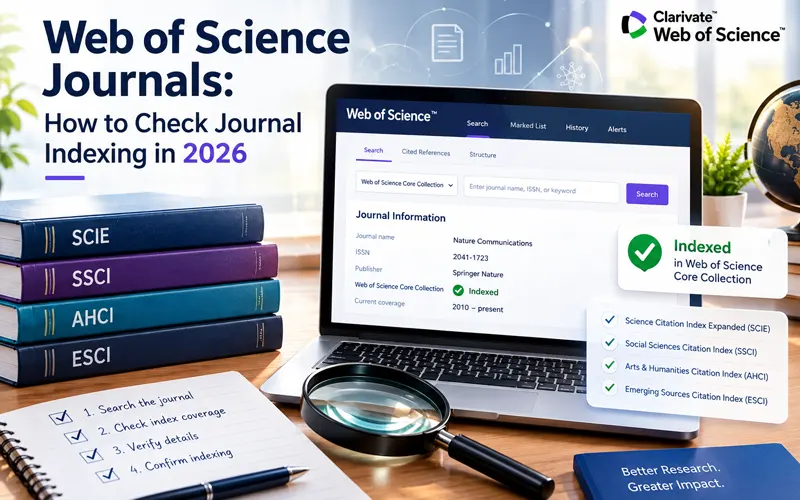
Web of Science Journals: How to Check if a Journal Is Indexed
Before submitting a research paper to a journal, one question should be answered independently:
Is this journal really indexed in Web of Science?
This may sound simple, but journal-indexing claims are often misunderstood.
A journal website may say that it is:
- internationally indexed;
- ISI listed;
- indexed by Clarivate;
- under evaluation for Web of Science;
- included in major databases;
- Impact Factor indexed.
None of these statements should be accepted without independent verification.
In 2026, researchers who need a genuine Web of Science journal should verify the journal through official Clarivate resources, particularly the Web of Science Master Journal List.
Clarivate reports that the Web of Science Core Collection currently indexes more than 22,000 journals across more than 250 disciplines and directs users to the freely available Master Journal List to check journal coverage and monthly changes.
This guide explains exactly how to check whether a journal is indexed in Web of Science, how to determine whether it belongs to SCIE, SSCI, AHCI, or ESCI, and how to avoid common mistakes that can lead researchers to submit to the wrong journal.
What Is a Web of Science Journal?
A Web of Science journal is a journal covered by one or more collections available through the Web of Science platform.
For researchers interested specifically in what is commonly called an ISI journal, the most relevant database is usually the:
Web of Science Core Collection
Within the Core Collection, the principal journal indexes are:
- Science Citation Index Expanded — SCIE
- Social Sciences Citation Index — SSCI
- Arts & Humanities Citation Index — AHCI
- Emerging Sources Citation Index — ESCI
These indexes cover different disciplinary areas and journal profiles.
A journal's presence somewhere on the broader Web of Science platform should therefore not automatically be interpreted as evidence that it belongs to the exact Core Collection index required by your university or institution.
Why Should You Check Web of Science Indexing Yourself?
Researchers sometimes rely on information provided by:
- journal websites;
- publishers;
- academic consultants;
- colleagues;
- social-media posts;
- downloaded journal lists;
- Google search results.
These sources can be useful for finding a journal, but they should not be your final evidence of indexing.
There are several reasons.
Journal Coverage Can Change
Web of Science is not a static database.
Clarivate states that its journal collections are dynamic and subject to periodic re-evaluation. Journals can move between ESCI and flagship indexes, and journals that no longer meet required quality criteria can be removed from the Core Collection.
Therefore, a journal that was indexed two years ago may not necessarily have the same status today.
Journal Websites May Contain Outdated Information
A legitimate journal may simply fail to update its indexing page immediately.
More seriously, a deceptive or hijacked journal website may display misleading indexing information.
Independent verification is therefore essential.
Institutional Requirements Differ
Your university may require:
- SCIE;
- SSCI;
- SCIE or SSCI;
- any Web of Science Core Collection journal;
- a journal with JIF;
- Q1 or Q2 status;
- a specific subject category.
These are different requirements.
Checking only whether a journal appears somewhere in Web of Science may not be sufficient.
What Is the Web of Science Master Journal List?
The Web of Science Master Journal List, usually abbreviated as MJL, is Clarivate's official journal-search resource.
It allows users to:
- search journals;
- search by ISSN;
- identify journal collections;
- examine journal coverage information;
- explore subject areas;
- review journal records;
- access title-list information.
Clarivate describes the Master Journal List as a resource for browsing, searching, and exploring journals indexed across Web of Science collections.
For journal verification, it should be one of your primary sources.
How to Check if a Journal Is Indexed in Web of Science: Step by Step
Step 1: Find the Exact Journal Name
Start with the complete official title.
Avoid relying on abbreviated names.
For example, a title such as:
International Journal of Medical Research
could easily be confused with another journal containing similar words.
Exact identification matters.
Step 2: Find the ISSN or eISSN
The International Standard Serial Number (ISSN) is usually more reliable than the journal title alone.
A journal may have:
- a print ISSN;
- an electronic ISSN;
- both.
Example format:
ISSN: 1234-5678
Using the ISSN reduces confusion between journals with similar names.
Step 3: Open the Official Master Journal List
Go to the Clarivate Master Journal List.
The journal search interface allows users to search using journal information such as title or ISSN.
Avoid beginning your verification with a random third-party “ISI list.”
Step 4: Search by ISSN First
If the ISSN is available, use it.
This is often safer than searching only by title.
Then confirm:
- journal name;
- ISSN/eISSN;
- publisher;
- collection.
All important details should correspond to the journal you intend to submit to.
Step 5: Check the Collection
This is one of the most important steps.
If the journal is in the Web of Science Core Collection, determine whether it belongs to:
SCIE
Science Citation Index Expanded
SSCI
Social Sciences Citation Index
AHCI
Arts & Humanities Citation Index
ESCI
Emerging Sources Citation Index
Do not simply stop when you see the journal name.
The exact index may matter for your academic requirement.
Step 6: Confirm That You Are Looking at the Correct Journal
Check:
- title;
- ISSN;
- eISSN;
- publisher;
- subject field.
This is particularly important because journal titles can be extremely similar.
Step 7: Examine Coverage Information
Coverage information can help determine whether the journal is currently included and whether any changes have occurred.
Clarivate notes that the Master Journal List can also be used to view changes in coverage.
This is particularly important for older publications or journals whose current status may differ from their historical status.
Step 8: Check JCR Separately if Impact Factor or Quartile Matters
Web of Science indexing and Journal Citation Reports metrics are related but not identical questions.
After confirming indexing, check separately:
- Journal Impact Factor;
- Journal Citation Indicator;
- category;
- quartile;
- JCR year.
Do not assume that discovering a journal in Web of Science automatically answers all metric-related questions.
Web of Science Indexing vs Journal Impact Factor
This distinction is critical.
Web of Science Indexing
Answers:
Is this journal covered by the relevant Web of Science collection?
Journal Impact Factor
Answers:
What is the journal's current JIF according to Journal Citation Reports?
These are not the same question.
Clarivate states that journals accepted into Web of Science Core Collection before the relevant annual cutoff and remaining covered when JCR production begins can become eligible for JCR journal metrics.
Therefore, researchers should verify indexing and metrics independently.
How Can You Tell Whether a Journal Is SCIE?
Search the journal in the Master Journal List and inspect its Web of Science Core Collection coverage.
If the record identifies:
Science Citation Index Expanded (SCIE)
then the journal is currently included in SCIE according to the journal record.
SCIE is especially relevant to areas such as:
- medicine;
- health sciences;
- biology;
- chemistry;
- engineering;
- environmental sciences;
- computer science;
- agriculture;
- materials science.
How Can You Tell Whether a Journal Is SSCI?
The same process applies.
If the journal record shows:
Social Sciences Citation Index (SSCI)
then it belongs to the SSCI collection.
SSCI commonly covers fields including:
- economics;
- management;
- education;
- psychology;
- sociology;
- political science;
- communication;
- public administration;
- social policy;
- urban studies.
How Can You Tell Whether a Journal Is AHCI?
Look for:
Arts & Humanities Citation Index (AHCI)
This collection covers fields including:
- literature;
- history;
- philosophy;
- art;
- linguistics;
- religious studies;
- cultural studies;
- film;
- humanities.
How Can You Tell Whether a Journal Is ESCI?
Look for:
Emerging Sources Citation Index (ESCI)
ESCI is part of the Web of Science Core Collection.
Clarivate explains that journals satisfying its quality criteria enter ESCI, while journals that also satisfy additional impact criteria can enter SCIE, SSCI, or AHCI depending on subject area.
Therefore:
ESCI does not mean “not Web of Science indexed.”
However, your institution may distinguish between ESCI and SCIE/SSCI for promotion, graduation, or funding purposes.
Always check local regulations.
What If a Journal Appears in Web of Science but Not in SCIE, SSCI, AHCI, or ESCI?
The Web of Science platform includes more than just the Core Collection.
The Master Journal List can also search specialty collections such as Biological Abstracts, BIOSIS Previews, Zoological Record, and Current Contents Connect.
This means that:
appearing somewhere in Web of Science is not automatically equivalent to being indexed in the specific Core Collection required by your institution.
Always inspect the exact collection.
Is “Web of Science Indexed” the Same as “ISI Indexed”?
In current academic usage, the term ISI indexed journal is often used informally to refer to journals indexed in Web of Science.
However, “ISI” is a historical term.
For current verification, the important concepts are:
- Clarivate;
- Web of Science;
- Web of Science Core Collection;
- SCIE;
- SSCI;
- AHCI;
- ESCI.
If formal reporting is required, use the precise current index rather than merely writing “ISI.”
For example:
Indexed in the Science Citation Index Expanded (SCIE), Web of Science Core Collection.
is more precise than:
ISI journal.
Is ESCI a Web of Science Index?
Yes.
ESCI is part of the Web of Science Core Collection.
This is a frequent source of confusion.
Some researchers incorrectly divide journals into:
- ISI journals;
- ESCI journals.
That distinction is technically misleading because ESCI itself belongs to the Core Collection.
The more meaningful distinction is between:
- ESCI;
- SCIE;
- SSCI;
- AHCI.
What Is the Difference Between SCIE and ESCI?
According to Clarivate's current journal-evaluation framework, journals are evaluated using 28 criteria:
- 24 quality criteria;
- 4 impact criteria.
Journals meeting the quality criteria can enter ESCI.
Those meeting the additional impact criteria can enter SCIE, SSCI, or AHCI depending on subject area.
This means the distinction is not simply:
“good journal” versus “bad journal.”
Both are curated Web of Science collections, but their evaluation status differs.
Can an ESCI Journal Become SCIE or SSCI?
Yes.
Clarivate describes the collection as dynamic.
An ESCI journal that demonstrates sufficient citation impact may be re-evaluated and move into:
- SCIE;
- SSCI;
- AHCI.
Conversely, a flagship journal whose impact decreases may move to ESCI.
This is another reason why old journal lists should not be treated as permanent.
Can a Web of Science Journal Lose Its Indexing?
Yes.
Clarivate states that journals failing to maintain its required quality criteria can be removed from Web of Science Core Collection.
The Master Journal List also warns that Clarivate may remove titles from coverage when they no longer maintain required standards or comply with relevant ethical requirements.
Therefore, indexing should be checked close to the time of submission.
What Happens to Articles After a Journal Is Removed?
The precise effect depends on coverage dates and Clarivate's indexing policy.
The Master Journal List states that when a journal is deselected, it ceases to be indexed from the date determined by Web of Science editors, and articles published after that point will not be indexed.
For this reason, researchers should pay attention not only to whether a journal has ever been indexed, but also to the relevant coverage period.
Can a Journal Say “Under Evaluation by Web of Science”?
A publisher may submit a journal for evaluation.
However:
being under evaluation is not the same as being indexed.
Clarivate's process involves editorial evaluation and, after provisional acceptance, technical onboarding before complete indexing begins.
Therefore, statements such as:
- submitted to Web of Science;
- under Clarivate evaluation;
- awaiting indexing;
should never be treated as confirmation of current coverage.
Can a Newly Accepted Journal Appear Immediately?
Not necessarily.
Clarivate explains that after a journal passes editorial evaluation and is provisionally accepted, it undergoes a technical onboarding stage to ensure that journal files and metadata are compatible with indexing requirements.
This means acceptance into the evaluation process and actual content indexing are operationally distinct stages.
How to Check Whether a Journal Has a Real Impact Factor
After verifying indexing, researchers may want to check whether the journal has an official Journal Impact Factor (JIF).
Use the official Journal Citation Reports information.
Do not confuse the JIF with metrics carrying names such as:
- Global Impact Factor;
- Universal Impact Factor;
- International Impact Factor;
- Scientific Impact Factor;
- Academic Impact Factor.
A metric containing the words “impact factor” is not automatically the Clarivate Journal Impact Factor.
How to Check Whether a Journal Is Q1, Q2, Q3, or Q4
If quartile matters, verify the relevant ranking year and category.
A journal may belong to several categories.
For example:
Journal X
- Q1 in Category A
- Q2 in Category B
Therefore, the statement:
“Journal X is Q1”
may be incomplete without identifying:
- ranking source;
- year;
- subject category.
Web of Science Q1 Is Not Always the Same as Scopus Q1
This is another common source of mistakes.
A journal can simultaneously be:
- JCR Q2;
- Scopus Q1.
That is possible because the databases use different:
- source sets;
- categories;
- citation metrics;
- ranking procedures.
If your institution asks specifically for a Web of Science/JCR quartile, do not substitute a Scopus quartile.
How to Check a Journal Using Its ISSN
A reliable workflow is:
1. Copy the ISSN from the publisher's official journal page.
2. Search the ISSN in the Master Journal List.
3. Confirm the journal title.
4. Confirm the publisher.
5. Check the Web of Science collection.
6. Review coverage information.
7. Check JCR separately if ranking information is required.
ISSN-based verification is particularly useful when several journals have similar names.
How to Check a Journal Using Its Title
If no ISSN is available:
- Search the exact journal title.
- Compare similar results.
- Check publisher information.
- identify ISSN/eISSN.
- confirm the journal's index.
Do not rely on partial title matches.
How to Detect a Fake Web of Science Claim
Treat the following claims cautiously:
- “ISI approved”
- “ISI certified”
- “ISI candidate”
- “Thomson Reuters accepted”
- “Web of Science pending”
- “Clarivate applied”
- “ISI international journal”
None of these expressions proves current indexing.
The decisive question is:
Can you locate the correct journal record and verify the required collection through official Clarivate resources?
How to Avoid Hijacked Journals
A hijacked journal is a fraudulent website that imitates a real academic journal.
This is particularly dangerous because:
- the journal name may be genuine;
- the ISSN may be copied from a genuine journal;
- the fake website may claim Web of Science indexing.
Researchers may therefore verify the name but still submit through the wrong website.
To reduce this risk, cross-check:
- journal name;
- ISSN;
- publisher;
- official journal domain;
- editorial board;
- contact information;
- submission system.
Never assume that the first Google result is necessarily the legitimate journal website.
Journal Verification Checklist
Before submitting a paper, confirm all of the following.
Identity
- Exact journal title
- ISSN
- eISSN
- Publisher
Indexing
- Listed in the Master Journal List
- Correct Web of Science collection
- Current coverage status
- Relevant coverage dates
Ranking
- Current JIF if required
- JCR year
- Subject category
- Quartile
Scope
- Topic fit
- Article type
- Methodological fit
- Geographic relevance
Legitimacy
- Official publisher website
- Authentic submission system
- Transparent editorial board
- Clear publication ethics
- Transparent fees
Common Mistakes When Checking Web of Science Journals
Mistake 1: Googling “Journal Name + ISI”
Search-engine results are not authoritative proof.
Use them to locate information, not to establish indexing status.
Mistake 2: Trusting a Screenshot
Screenshots can be:
- outdated;
- cropped;
- manipulated;
- taken from a different database.
Verify the journal directly.
Mistake 3: Trusting Old PDF or Excel Lists
Static journal lists become outdated.
Always recheck current status.
Mistake 4: Confusing Scopus with Web of Science
A Scopus journal is not automatically a Web of Science journal.
Mistake 5: Checking Only the Journal Name
Use the ISSN whenever possible.
Mistake 6: Ignoring the Exact Collection
A journal may appear in a specialty Web of Science database without meeting your requirement for SCIE, SSCI, AHCI, or ESCI.
Mistake 7: Treating “Under Evaluation” as Indexed
Evaluation is not indexing.
Mistake 8: Assuming Indexing Is Permanent
Web of Science coverage can change.
Mistake 9: Confusing JIF with Indexing
Impact Factor and indexing should be checked separately.
Mistake 10: Confusing JCR Quartile with Scopus Quartile
Always identify the database and category.
When Should You Verify Journal Indexing?
Researchers often verify only once.
A safer approach is to check at multiple stages.
Before Selecting the Journal
Ensure it meets your basic requirements.
Immediately Before Submission
Confirm there has been no change.
Before Paying an APC
Recheck indexing and journal identity before making a significant payment.
During a Long Revision Process
If the review process takes many months, verify status again.
Before Institutional Reporting
Check the journal status relevant to your university's rules.
Should You Select a Journal Only Because It Is Indexed?
No.
Verification tells you whether the journal satisfies an indexing condition.
It does not tell you whether the journal is right for your paper.
After verification, evaluate:
- aims and scope;
- recently published articles;
- study-design preference;
- novelty expectations;
- readership;
- quartile;
- Impact Factor;
- article processing charges;
- review model;
- publication requirements.
A correctly indexed but poorly matched journal can still be a poor submission target.
Web of Science Verification and Journal Selection Are Different Tasks
This distinction is useful.
Journal Verification
Answers:
Is the journal really indexed, and where?
Journal Selection
Answers:
Is this journal a suitable and realistic target for my manuscript?
A proper publication strategy requires both.
Example of a Good Verification Workflow
Suppose a researcher finds a journal called Journal X.
The journal website claims:
Indexed in Web of Science.
The researcher should not submit immediately.
Instead:
Step 1
Find Journal X's ISSN.
Step 2
Search the ISSN in the Master Journal List.
Step 3
Confirm that the journal title and publisher match.
Step 4
Identify whether it is:
- SCIE;
- SSCI;
- AHCI;
- ESCI.
Step 5
Check relevant coverage information.
Step 6
If Impact Factor or quartile matters, verify the current JCR data.
Step 7
Return to the journal website and examine:
- aims and scope;
- author guidelines;
- APC;
- recent publications.
Step 8
Only then make the submission decision.
This process may take only a few minutes but can prevent months of wasted effort.
Frequently Asked Questions
How do I know if a journal is indexed in Web of Science?
Search the exact journal title or ISSN in the Web of Science Master Journal List and check the listed collection and coverage information.
What is the official Web of Science journal list?
The Web of Science Master Journal List is Clarivate's official journal-search resource.
Is ESCI part of Web of Science?
Yes. ESCI is part of the Web of Science Core Collection.
Is SCIE the same as Web of Science?
SCIE is one of the citation indexes within the Web of Science Core Collection.
Is SSCI part of Web of Science?
Yes. SSCI is one of the flagship citation indexes in the Web of Science Core Collection.
Is AHCI part of Web of Science?
Yes. AHCI covers arts and humanities journals within the Core Collection.
Can a journal be removed from Web of Science?
Yes. Journals are periodically re-evaluated and can be removed if they no longer satisfy required criteria.
Can an ESCI journal move to SCIE or SSCI?
Yes. Web of Science collections are dynamic, and eligible journals may move between collections following re-evaluation.
Does Web of Science indexing guarantee an Impact Factor?
Indexing and JIF eligibility are separate issues that should be checked independently.
Can a Scopus journal also be in Web of Science?
Yes. Many journals are indexed in both databases.
Is every Scopus journal a Web of Science journal?
No.
Is “under evaluation by Web of Science” the same as indexed?
No.
Should I search by ISSN?
Yes. ISSN is generally one of the safest ways to identify the correct journal.
Is a journal's own website sufficient proof?
No. Always verify through an independent official source.
Can I trust a downloadable ISI journal list?
It can be useful for preliminary searching, but final verification should be performed using current Clarivate information.
Final Web of Science Journal Verification Checklist
Before submitting your manuscript, answer yes to each relevant question:
- Have I identified the exact journal?
- Have I checked its ISSN/eISSN?
- Have I searched it in the Master Journal List?
- Does the publisher information match?
- Do I know whether it is SCIE, SSCI, AHCI, or ESCI?
- Have I checked current coverage?
- Have I distinguished Web of Science indexing from Scopus indexing?
- Have I checked JIF separately if required?
- Have I checked the relevant quartile and category?
- Have I verified the legitimate journal website?
- Have I reviewed the aims and scope?
- Have I checked publication fees?
- Have I avoided relying on an unofficial screenshot or old journal list?
If the answer to an important question is “no,” complete the verification before submitting.
Conclusion
Checking whether a journal is indexed in Web of Science should be a routine part of every serious publication strategy.
The safest workflow is:
Identify the journal → obtain the ISSN → search the Master Journal List → verify the journal identity → confirm SCIE/SSCI/AHCI/ESCI status → examine coverage → check JCR metrics separately if required → assess scope → submit through the legitimate journal website.
Researchers should never rely only on:
- a journal's advertising;
- an unofficial ISI list;
- a screenshot;
- an old Excel file;
- a claim that the journal is “under evaluation.”
Web of Science coverage is dynamic, and Clarivate continuously evaluates journal quality.
Taking a few minutes to verify a journal before submission can prevent:
- submission to a fake journal;
- payment to a hijacked website;
- publication in a journal that does not meet university requirements;
- months lost in an unsuitable submission process.
In academic publishing, verification should come before submission.
Need Help Verifying a Web of Science Journal?
TADBIRSAZ can assist researchers with:
- Web of Science journal verification;
- SCIE, SSCI, AHCI, and ESCI status checking;
- journal–manuscript matching;
- quartile and indexing assessment;
- manuscript evaluation;
- academic editing;
- submission preparation;
- revision and reviewer-response support.
Professional journal support should never replace independent editorial decision-making or guarantee acceptance. Its purpose is to help researchers select legitimate, appropriate journals and prepare manuscripts that meet scholarly and technical requirements.
Explore TADBIRSAZ ISI / Web of Science Journal Publication Services for journal verification and manuscript support.