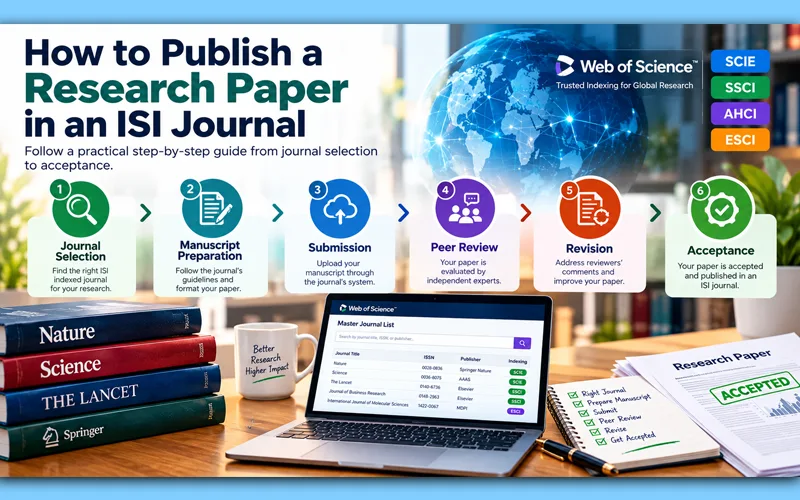
How to Publish a Research Paper in an ISI Journal: Step-by-Step Guide
Publishing a research paper in an ISI or Web of Science indexed journal is an important academic goal for many researchers, PhD students, university faculty members, and postgraduate scholars.
However, publication is not simply a matter of writing a paper and sending it to a high-ranking journal.
Successful journal publication usually depends on a sequence of interconnected decisions:
- choosing a suitable research question;
- designing a methodologically sound study;
- preparing a publication-ready manuscript;
- selecting the right journal;
- complying with author guidelines;
- preparing all required submission files;
- responding effectively to peer reviewers;
- revising the manuscript carefully.
A weak decision at any of these stages can lead to rejection even if the underlying research is valuable.
This guide explains how to publish a research paper in an ISI journal step by step, from manuscript preparation to final acceptance.
What Does “Publishing in an ISI Journal” Mean?
The term ISI journal is still widely used by researchers, although the modern and more accurate framework is based on journals indexed in the Web of Science Core Collection.
These journals may be included in indexes such as:
- Science Citation Index Expanded — SCIE
- Social Sciences Citation Index — SSCI
- Arts & Humanities Citation Index — AHCI
- Emerging Sources Citation Index — ESCI
Therefore, when researchers ask:
“How can I publish in an ISI journal?”
they usually mean:
“How can I publish in a reputable journal indexed in Web of Science?”
The publication process itself is similar across many academic journals, although specific requirements differ by publisher and discipline.
Step 1: Start with a Publishable Research Question
The publication process begins long before manuscript submission.
A journal editor evaluates whether your paper makes a meaningful contribution to the field.
A strong research question should be:
- clear;
- specific;
- theoretically grounded;
- methodologically answerable;
- relevant to current literature;
- sufficiently original.
A common mistake is to assume that any completed thesis, dissertation, survey, experiment, or dataset can automatically be converted into a journal article.
This is not always true.
A publishable paper usually needs a focused contribution rather than a broad description of everything included in a thesis or research project.
Ask These Questions Before Writing
Before preparing the manuscript, ask:
- What exact problem does the paper address?
- What is already known?
- What remains uncertain?
- What does this study add?
- Why should the journal's readers care?
- Is the contribution theoretical, methodological, empirical, clinical, technological, or policy-oriented?
- Are the data strong enough to support the conclusions?
If these questions cannot be answered clearly, the manuscript may require conceptual revision before journal submission.
Step 2: Conduct a Current Literature Review
A strong ISI journal article must be positioned within current scholarly literature.
The literature review should not be a long collection of unrelated citations.
Instead, it should establish:
- the current state of knowledge;
- competing explanations;
- methodological limitations;
- unresolved questions;
- the specific research gap.
Researchers should prioritize reliable academic sources such as:
- peer-reviewed journal articles;
- systematic reviews;
- meta-analyses;
- authoritative academic books;
- recognized institutional reports where relevant.
For fast-moving fields, recent literature is especially important.
A manuscript may be rejected if its introduction presents a research gap that has already been addressed by newer studies.
Step 3: Identify the Main Contribution of the Paper
Editors often make an early judgment based on one question:
What is new here?
Novelty does not always mean discovering something completely unknown.
A paper may contribute through:
- a new dataset;
- a new population;
- a new geographical context;
- a new theoretical integration;
- a stronger research design;
- a new analytical method;
- a new comparison;
- a new intervention;
- a novel application;
- replication under different conditions.
The novelty claim should be realistic.
Avoid exaggerated statements such as:
“This is the first study in the world…”
unless you can verify that claim systematically.
A more defensible statement may be:
“Few studies have examined…”
or:
“Previous evidence remains limited regarding…”
Step 4: Make Sure the Study Design Is Methodologically Sound
A polished manuscript cannot compensate for fundamentally weak methodology.
Before targeting an ISI journal, assess whether the study design is appropriate for the research question.
Depending on the field, this may involve reviewing:
- sample size;
- sampling strategy;
- measurement validity;
- reliability;
- statistical power;
- missing data;
- confounding;
- model assumptions;
- control variables;
- ethical approval;
- reproducibility;
- robustness checks.
For qualitative studies, relevant issues may include:
- sampling logic;
- saturation;
- interview design;
- coding procedure;
- researcher reflexivity;
- credibility and transferability.
For systematic reviews and meta-analyses, researchers should examine:
- protocol;
- database coverage;
- eligibility criteria;
- screening;
- risk-of-bias assessment;
- effect-size calculation;
- heterogeneity;
- publication bias.
Methodological problems are among the most serious reasons for rejection because they cannot always be corrected after data collection is complete.
Step 5: Select the Right ISI Journal
Choosing the journal is one of the most important stages in the publication process.
Do not select a journal based only on Impact Factor or quartile.
The strongest target journal is usually one that balances:
scope fit + scientific quality + realistic selectivity + audience relevance
Check the Journal's Aims and Scope
Read the journal's official aims and scope carefully.
Ask:
- Does the journal publish my topic?
- Does it accept my study design?
- Does it publish research from my geographical region?
- Does it accept my article type?
- Have similar papers appeared recently?
Read Recent Articles
Review at least 10–20 recent papers from the journal.
This helps you understand:
- methodological expectations;
- writing style;
- article length;
- preferred topics;
- theoretical depth;
- statistical sophistication.
A journal's recent publications often provide more practical information than its general scope statement.
Check Indexing
Before submission, verify that the journal is currently covered by the required Web of Science index.
Do not rely exclusively on:
- journal advertisements;
- old lists;
- screenshots;
- third-party databases;
- social media claims.
Use the relevant official indexing resources.
Step 6: Evaluate Journal Quality and Ranking
After confirming scope, evaluate the journal's current standing.
Possible indicators include:
- Web of Science index;
- Journal Impact Factor;
- Journal Citation Indicator;
- JCR category;
- quartile;
- CiteScore;
- SJR;
- Scopus coverage.
However, metrics should support journal selection rather than replace it.
A Q1 journal with poor scope fit may be a weaker target than a well-matched Q2 or Q3 journal.
Step 7: Decide on a Realistic Journal Strategy
One useful approach is to create a tiered journal shortlist.
For example:
Target A
Highly desirable journal with strong scope fit but relatively high selectivity.
Target B
Good quality journal with strong methodological and topical fit.
Target C
More realistic journal with acceptable indexing and a broader scope.
This prevents researchers from restarting the journal search after every rejection.
A well-designed submission strategy may save several months.
Step 8: Read the Author Guidelines Before Finalizing the Manuscript
Every journal has its own instructions.
Before submission, check:
- article type;
- word count;
- abstract structure;
- reference style;
- heading structure;
- figure requirements;
- table format;
- supplementary files;
- reporting guidelines;
- anonymization requirements;
- title-page format;
- declaration requirements.
Some journals conduct an initial technical check before editorial review.
Failure to follow the instructions can delay the submission or lead to administrative return.
Step 9: Structure the Manuscript Properly
A typical original research paper includes:
- Title
- Abstract
- Keywords
- Introduction
- Methods
- Results
- Discussion
- Conclusion
- Declarations
- References
- Tables and figures
- Supplementary materials where applicable
The exact structure depends on the journal and discipline.
Step 10: Write a Strong Title
The title should accurately communicate:
- the main topic;
- the main variables or phenomenon;
- the study design where relevant;
- the population or setting where useful.
Avoid:
- unnecessarily long titles;
- vague titles;
- promotional language;
- unsupported claims.
A strong title improves discoverability and helps editors understand the paper immediately.
Step 11: Write an Effective Abstract
The abstract is one of the most important parts of the manuscript.
Editors and reviewers often form their first substantive impression from the abstract.
A strong abstract should clearly communicate:
- background;
- objective;
- methods;
- principal results;
- conclusion.
Avoid filling the abstract with general background information.
The results should contain actual findings whenever the journal allows this.
For quantitative research, include relevant numerical results where appropriate.
Step 12: Choose Effective Keywords
Keywords improve discoverability.
Choose terms that reflect:
- main concept;
- population;
- method;
- discipline;
- important outcome.
Avoid simply repeating every word from the title.
Check whether the journal requires controlled vocabulary such as MeSH terms in biomedical fields.
Step 13: Build a Focused Introduction
The introduction should answer four questions:
- What is the problem?
- What is already known?
- What is missing?
- What does this study do?
A common and effective structure is:
Paragraph 1
Introduce the broader problem and its importance.
Paragraph 2
Summarize the key evidence.
Paragraph 3
Identify the unresolved gap.
Final Paragraph
State the research objective, hypothesis, or research question.
Do not turn the introduction into a long textbook-style literature review.
Step 14: Make the Methods Reproducible
The methods section should allow another competent researcher to understand how the study was conducted.
Depending on the study, report:
- design;
- setting;
- participants;
- eligibility criteria;
- sampling;
- variables;
- instruments;
- procedures;
- statistical analysis;
- software;
- ethical approval.
Avoid vague statements such as:
“The data were analyzed statistically.”
Specify the actual analyses performed.
Step 15: Report Results Without Overinterpreting Them
The Results section should present the findings objectively.
Include:
- participant characteristics;
- descriptive statistics;
- primary analyses;
- secondary analyses;
- confidence intervals where appropriate;
- effect sizes where relevant;
- p-values where relevant;
- sensitivity analyses where applicable.
Do not repeat every table value in prose.
The text should highlight the most important findings.
Interpretation belongs primarily in the Discussion section.
Step 16: Write a Strong Discussion
A strong Discussion usually includes:
1. Main Findings
Briefly summarize the principal findings.
2. Comparison with Previous Research
Explain whether the findings:
- confirm;
- contradict;
- extend;
- refine
previous evidence.
3. Mechanisms or Explanations
Discuss plausible explanations.
4. Implications
Explain the theoretical, clinical, policy, managerial, or practical implications.
5. Strengths and Limitations
Discuss real limitations rather than generic ones.
6. Future Research
Identify specific next steps.
Avoid simply repeating the Results section.
Step 17: Do Not Overstate the Conclusions
Conclusions should match the research design.
For example:
A cross-sectional study generally cannot establish causality.
An observational study should not automatically use causal language.
A small single-center study should not make broad population-level claims without qualification.
Reviewers are highly sensitive to overinterpretation.
Step 18: Follow Appropriate Reporting Guidelines
Depending on study design, the journal may expect specific reporting standards.
Common examples include:
- CONSORT for randomized trials;
- STROBE for observational studies;
- PRISMA for systematic reviews;
- CARE for case reports;
- STARD for diagnostic accuracy studies;
- COREQ for qualitative research;
- ARRIVE for animal research.
Using the correct reporting guideline can improve manuscript completeness and transparency.
Step 19: Check Research Ethics Requirements
Many journals require formal ethical documentation.
Depending on the study, this may include:
- institutional review board approval;
- ethics committee approval;
- informed consent;
- trial registration;
- consent for publication;
- animal ethics approval;
- data protection measures.
Never invent ethical approval.
If approval was not required, explain why according to the applicable institutional or legal framework.
Step 20: Prepare All Required Declarations
Journals frequently require sections such as:
- Funding
- Conflict of Interest
- Author Contributions
- Data Availability
- Ethics Approval
- Consent to Participate
- Consent for Publication
- Acknowledgments
These statements should be accurate and consistent with the submission metadata.
Step 21: Check Authorship Before Submission
Authorship disputes can create serious ethical problems.
Before submission, confirm:
- author order;
- corresponding author;
- affiliations;
- ORCID information;
- contribution statements.
Only people who meet legitimate authorship criteria should be listed as authors.
Do not add honorary or guest authors merely to improve the perceived prestige of the manuscript.
Step 22: Review the References Carefully
Reference problems are common.
Check:
- all in-text citations appear in the reference list;
- all reference-list entries are cited in the text;
- author names are correct;
- article titles are correct;
- journal names are correct;
- year, volume, issue, and pages are correct;
- DOI information is correct where included.
Never invent references.
Incorrect or fabricated references can seriously damage manuscript credibility.
Step 23: Improve Academic English
A scientifically strong manuscript can still be difficult to review if the language is unclear.
Academic editing should improve:
- grammar;
- syntax;
- terminology;
- logical flow;
- concision;
- paragraph structure;
- consistency.
The goal is not to make the language unnecessarily complicated.
Good academic writing is usually:
precise + concise + logically structured
rather than ornate.
Step 24: Check for Internal Consistency
Before submission, verify that all sections agree with one another.
Common inconsistencies include:
- different sample sizes in the abstract and results;
- different study dates;
- mismatched table values;
- inconsistent variable names;
- conflicting hypotheses;
- conclusions not supported by results.
Perform a final consistency audit.
Step 25: Check Tables and Figures
Tables and figures should add information, not duplicate the text.
Check:
- numbering;
- titles;
- captions;
- legends;
- abbreviations;
- units;
- resolution;
- statistical notation.
All tables and figures should be cited in the manuscript in the correct order.
Step 26: Prepare the Cover Letter
Many journals allow or require a cover letter.
A strong cover letter should briefly state:
- manuscript title;
- research problem;
- main contribution;
- why the manuscript fits the journal;
- originality;
- ethical compliance where relevant.
Avoid exaggerated claims.
Do not write:
“This paper will revolutionize the field.”
Instead, explain the contribution objectively.
Step 27: Create an Account in the Journal Submission System
Academic journals may use platforms such as:
- Editorial Manager;
- ScholarOne Manuscripts;
- publisher-specific submission portals.
Make sure the corresponding author's details are correct.
Common metadata include:
- title;
- abstract;
- keywords;
- authors;
- affiliations;
- ORCID;
- funding;
- suggested reviewers;
- conflicts of interest.
Submission metadata should match the manuscript.
Step 28: Upload the Correct Files
Common submission files include:
- main manuscript;
- title page;
- figures;
- supplementary material;
- cover letter;
- reporting checklist;
- graphical abstract;
- ethics documents where required.
Some journals require blinded manuscripts.
In double-anonymous review, remove identifying information from the main manuscript if instructed.
Step 29: Check the Proof Before Final Submission
Do not click “Submit” immediately after uploading files.
Download or preview the generated PDF.
Check:
- formulas;
- special characters;
- figures;
- tables;
- author names;
- affiliations;
- abstract;
- supplementary files.
Formatting errors can occur during conversion.
Step 30: Understand Editorial Screening
After submission, the manuscript usually undergoes an initial editorial check.
Possible outcomes include:
- sent for peer review;
- desk rejection;
- technical return;
- request for preliminary revisions;
- transfer suggestion.
Desk rejection does not necessarily mean the study is poor.
Common reasons include:
- scope mismatch;
- insufficient novelty;
- weak methodology;
- low priority;
- poor presentation;
- incomplete submission.
Step 31: Understand Peer Review
If the paper passes editorial screening, it may be sent to external reviewers.
Reviewers may evaluate:
- novelty;
- methodology;
- analysis;
- literature;
- interpretation;
- clarity;
- ethical issues.
Possible editorial decisions include:
- accept;
- minor revision;
- major revision;
- revise and resubmit;
- reject.
Initial acceptance without revision is uncommon in many disciplines.
Step 32: Respond to Reviewer Comments Systematically
A revision decision is often a positive sign.
Do not respond emotionally or defensively.
Create a point-by-point response.
For each comment:
- reproduce or summarize the reviewer comment;
- explain your response;
- describe the change;
- identify where it was made.
If you disagree with a reviewer, explain why respectfully and scientifically.
Do not ignore comments.
Step 33: Distinguish Minor from Major Revision
Minor Revision
Usually involves:
- clarification;
- small additions;
- formatting;
- limited analysis;
- wording changes.
Major Revision
May involve:
- substantial rewriting;
- additional analysis;
- theoretical restructuring;
- methodological clarification;
- new robustness tests;
- major discussion changes.
A major revision is not acceptance, but it generally indicates that the editor sees potential in the paper.
Step 34: Never Fabricate Additional Data to Satisfy Reviewers
If a reviewer requests an analysis or experiment that cannot legitimately be performed, explain the limitation.
Researchers should never:
- invent data;
- fabricate experiments;
- create nonexistent participants;
- alter results dishonestly.
Scientific integrity is more important than obtaining acceptance.
Step 35: Resubmit Before the Deadline
Revision decisions usually include a deadline.
Before resubmission, prepare:
- revised manuscript;
- clean manuscript if required;
- tracked-changes version if required;
- response-to-reviewers document;
- updated supplementary files.
Ensure that every reviewer comment has been addressed.
Step 36: Handle Rejection Strategically
Rejection is common in academic publishing.
After rejection:
- read the editor's comments carefully;
- identify correctable weaknesses;
- revise the paper;
- select the next appropriate journal;
- reformat;
- submit again.
Do not immediately submit the unchanged manuscript elsewhere if reviewers have identified genuine problems.
A rejected manuscript can often become substantially stronger after revision.
Step 37: Avoid Simultaneous Submission
Do not submit the same manuscript to multiple journals at the same time unless explicitly permitted, which is uncommon.
Simultaneous submission is generally considered a breach of publication ethics.
Wait for a formal decision or withdraw the manuscript before submitting it elsewhere.
Step 38: Understand Publication Fees
Not all ISI journals charge publication fees.
Possible models include:
Subscription Journal
Usually no mandatory open-access APC for standard publication.
Hybrid Journal
Subscription journal with optional paid open access.
Fully Open Access Journal
Usually requires an article processing charge, although waivers may exist.
Always check fees before submission.
Do not assume:
“Higher fee = better journal.”
Publication cost is not a reliable quality indicator.
Step 39: Avoid Predatory Journals
Warning signs include:
- guaranteed acceptance;
- extremely rapid peer review;
- fake metrics;
- misleading indexing claims;
- unclear publisher;
- suspicious editorial board;
- aggressive email solicitation;
- hidden fees.
Always verify indexing independently.
Step 40: Understand That Acceptance Cannot Be Guaranteed
No legitimate editor, academic consultant, researcher, or publication service can ethically guarantee acceptance in a genuine peer-reviewed journal.
Acceptance depends on:
- editor judgment;
- reviewer evaluation;
- journal priorities;
- competition;
- scientific quality;
- novelty;
- methodological rigor.
Professional support can improve manuscript quality and journal fit, but it cannot control editorial decisions.
How Long Does ISI Journal Publication Take?
There is no universal publication time.
The process may include:
- technical check;
- editorial screening;
- reviewer invitation;
- peer review;
- revision;
- second review;
- acceptance;
- production;
- online publication.
Timelines differ substantially between journals.
Researchers should avoid journals that promise unrealistically fast guaranteed publication.
How Many Times Can a Paper Be Rejected?
There is no fixed limit.
A manuscript may be rejected by several journals before acceptance.
However, repeated rejection should trigger reassessment.
Ask:
- Is the target journal too ambitious?
- Is the scope wrong?
- Is novelty insufficient?
- Is the methodology weak?
- Does the manuscript require rewriting?
Repeatedly resubmitting without addressing problems usually wastes time.
Can a Thesis Be Published in an ISI Journal?
Yes.
Many journal articles are derived from:
- master's theses;
- PhD dissertations;
- funded research projects.
However, a thesis chapter should not simply be copied into a journal manuscript.
A journal article requires a much more focused structure.
A typical dissertation may contain:
- extensive theoretical background;
- multiple research questions;
- detailed methodological explanations;
- several datasets;
- many findings.
A journal article generally emphasizes one coherent contribution.
Can One Thesis Produce Multiple ISI Articles?
Potentially, yes, if the studies are genuinely distinct.
Each article should have:
- a separate research question;
- a meaningful contribution;
- appropriate analysis;
- limited unnecessary overlap.
Researchers must avoid inappropriate fragmentation or “salami slicing.”
How to Increase Your Chances of ISI Journal Acceptance
There is no formula guaranteeing acceptance, but several practices improve submission quality:
- Choose a strong research question.
- Use a rigorous study design.
- Perform appropriate analysis.
- Use current literature.
- Define the novelty clearly.
- Select the journal carefully.
- Follow author guidelines exactly.
- Improve academic writing.
- Report limitations honestly.
- Use appropriate reporting guidelines.
- Verify references.
- Prepare a strong cover letter.
- Respond carefully to reviewers.
- Revise scientifically rather than cosmetically.
- Maintain publication ethics throughout the process.
Common Reasons ISI Journal Papers Are Rejected
The most common problems include:
- manuscript outside scope;
- insufficient novelty;
- weak methodology;
- inappropriate analysis;
- inadequate sample;
- poor literature positioning;
- unsupported conclusions;
- poor academic writing;
- incomplete reporting;
- ethical concerns;
- weak discussion;
- failure to follow instructions.
A rejection often results from several weaknesses rather than one isolated problem.
ISI Journal Publication Workflow
A practical publication workflow can be summarized as:
Research Question
↓
Study Design
↓
Data Collection or Evidence Acquisition
↓
Analysis
↓
Manuscript Drafting
↓
Scientific Revision
↓
Journal Selection
↓
Web of Science Verification
↓
Formatting
↓
Submission
↓
Editorial Screening
↓
Peer Review
↓
Revision
↓
Resubmission
↓
Acceptance
↓
Production and Publication
Treating publication as a structured workflow is more effective than treating submission as the final step of writing.
Frequently Asked Questions
How can I publish my first paper in an ISI journal?
Start with a methodologically sound study, prepare a focused manuscript, identify journals that publish similar research, verify their Web of Science status, follow the author guidelines, and submit through the official journal system.
Is it difficult to publish in an ISI journal?
Difficulty varies considerably. Highly selective journals require stronger novelty, methodology, and international significance than more specialized journals.
Do I need a PhD to publish in an ISI journal?
No. Journal publication is based primarily on the quality and suitability of the research, not possession of a particular academic degree.
Can a master's student publish in an ISI journal?
Yes. Students can publish if the research meets the journal's scientific and ethical requirements.
Can I publish without a university affiliation?
Some journals accept submissions from independent researchers, although institutional affiliation may be relevant to specific studies.
Can I publish an ISI paper without paying?
Yes. Many subscription journals do not require a mandatory APC for standard non-open-access publication.
Does paying an APC guarantee acceptance?
No. Legitimate journals conduct editorial assessment and peer review independently of payment.
How do I choose between Q1, Q2, Q3, and Q4 journals?
Consider manuscript quality, novelty, methodology, scope fit, institutional requirements, and realistic selectivity rather than quartile alone.
Should I choose the journal before writing the paper?
Ideally, identify a small group of potential journals during manuscript preparation. This helps align the paper with appropriate article types and reporting expectations.
What happens after submission?
The paper typically undergoes technical screening, editorial assessment, and potentially external peer review before a decision is issued.
What is a desk rejection?
A desk rejection occurs when an editor declines a manuscript before external peer review.
Is major revision a good sign?
It indicates that the journal is willing to consider a substantially revised manuscript, but it does not guarantee acceptance.
Can I disagree with a reviewer?
Yes. Provide a polite, evidence-based explanation rather than making a change you believe would be scientifically inappropriate.
Can I send my rejected paper to another journal?
Yes, after the first journal has issued a final rejection or the manuscript has been formally withdrawn.
Can journal acceptance be guaranteed?
No legitimate peer-reviewed publication process can guarantee acceptance.
A Final Pre-Submission Checklist
Before submitting your research paper to an ISI/Web of Science journal, confirm:
Scientific Quality
- Clear research question
- Defined contribution
- Appropriate methodology
- Correct statistical or qualitative analysis
- Conclusions supported by findings
Manuscript Quality
- Strong title
- Accurate abstract
- Focused introduction
- Reproducible methods
- Clear results
- Critical discussion
- Appropriate limitations
Journal Fit
- Correct aims and scope
- Correct article type
- Similar recent papers
- Appropriate audience
- Verified Web of Science coverage
Technical Requirements
- Correct formatting
- Correct reference style
- Tables and figures checked
- Supplementary files included
- Reporting guidelines completed
Ethics
- Ethics approval where required
- Informed consent where required
- Conflict-of-interest statement
- Funding statement
- Author contribution statement
- Data availability statement where required
Submission
- Cover letter
- Correct author metadata
- Correct manuscript files
- Final PDF checked
- Journal identity independently verified
Conclusion
Learning how to publish in an ISI journal requires more than understanding the submission portal.
Successful publication is a multi-stage research process that begins with a sound research question and ends only after the manuscript has survived editorial evaluation, peer review, revision, and final production.
The most effective workflow is:
Produce rigorous research → define the contribution → select a suitable journal → verify Web of Science indexing → prepare the manuscript carefully → comply with journal requirements → submit → respond scientifically to peer review.
Researchers should resist shortcuts such as:
- choosing journals based only on Impact Factor;
- using fake indexing lists;
- paying for guaranteed acceptance;
- submitting poorly revised manuscripts;
- fabricating data or references.
A strong publication strategy combines research integrity, methodological rigor, realistic journal selection, accurate presentation, and professional revision.
Need Help Publishing in a Web of Science Journal?
TADBIRSAZ provides academic publication support for researchers preparing manuscripts for SCIE, SSCI, AHCI, and ESCI journals.
Support may include:
- manuscript evaluation;
- journal selection;
- Web of Science journal verification;
- academic editing;
- scientific structure review;
- formatting;
- reference checking;
- submission preparation;
- cover letter preparation;
- reviewer-response editing;
- revision support.
The objective is to improve the manuscript's scientific quality, journal compatibility, and submission readiness while maintaining research and publication ethics.
Explore TADBIRSAZ ISI / Web of Science Journal Publication Services for professional support with your manuscript.