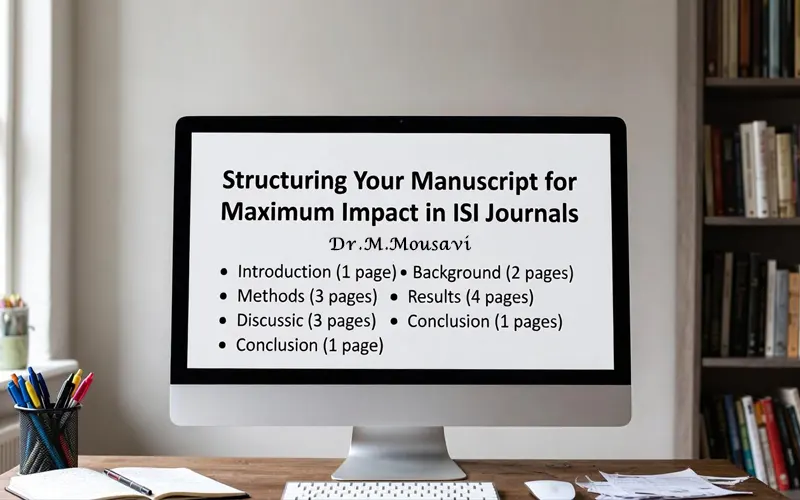
Introduction: The Importance of Manuscript Structure
A well-structured manuscript is a key factor in getting your paper, article, or manuscript accepted in ISI Web of Science journals. Editors and reviewers evaluate not only the quality of your research but also how clearly and logically it is presented. A manuscript with excellent content but poor structure can face delays, revisions, or even rejection.
At TadbirSaz Institute, we specialize in guiding researchers to craft manuscripts optimized for readability, impact, and acceptance, particularly in Q1 and Q2 journals indexed in SCI, SSCI, AHCI, ESCI, and Scopus. With our experienced team of 27 globally recognized experts—professors, associate professors, and assistant professors with h-index scores above 20—we provide comprehensive manuscript structuring, editing, and publication support.
1. The Standard Structure of an ISI Manuscript
Most ISI journals follow a standardized structure:
- Title: Clear, concise, and indicative of the study’s focus.
- Abstract: Summarizes the problem, methods, results, and conclusions.
- Keywords: 4–6 relevant terms to improve indexing and discoverability.
- Introduction: Explains research context, gap, and objectives.
- Methods / Materials: Detailed methodology enabling reproducibility.
- Results: Present findings clearly, often with figures, tables, and statistical analysis.
- Discussion: Interpret results, compare with existing literature, and explain significance.
- Conclusion: Summarize major findings and implications.
- References: Properly formatted citations following the journal’s style guide.
At TadbirSaz, we ensure each section is optimized for clarity, scientific rigor, and compliance with journal standards, increasing the chances of editorial acceptance and high-impact citations.
2. Writing a Strong Title and Abstract
- Titles should be concise, descriptive, and keyword-rich.
- Abstracts must highlight novelty, methodology, results, and significance in 150–300 words.
- TadbirSaz experts craft titles and abstracts that align with trending topics, journal priorities, and bibliometric insights.
3. Crafting the Introduction
- Present the research problem clearly and explain its importance.
- Review relevant literature to demonstrate knowledge of the field.
- State objectives, hypotheses, or research questions.
- TadbirSaz ensures introductions are engaging, logically structured, and aligned with journal scope, enhancing editor and reviewer interest.
4. Methods and Materials Section
- Provide detailed methodology, including experimental design, instruments, statistical analyses, or modeling approaches.
- Ensure reproducibility, which is critical for ISI journals.
- TadbirSaz supports authors with advanced statistical analysis, methodology validation, and alignment with journal requirements.
5. Presenting Results Effectively
- Use figures, tables, and charts to summarize data.
- Highlight key findings with clear narrative and quantitative support.
- Integrate bibliometric insights, such as expected citation impact, to underscore significance.
- TadbirSaz provides professional figure preparation, data visualization, and formatting for top-tier publishers like Elsevier, Springer, Wiley, Taylor & Francis, MDPI, Nature Publishing, and IEEE.
6. Writing the Discussion
- Compare results with previous studies.
- Highlight novel contributions and implications.
- Address limitations and future research directions.
- TadbirSaz ensures the discussion balances technical depth with readability, maintaining alignment with editorial expectations.
7. Crafting the Conclusion
- Summarize main findings concisely.
- Emphasize scientific and practical significance.
- TadbirSaz helps authors frame conclusions strategically, boosting acceptance likelihood and citation potential.
8. Reference Management
- Use proper citation styles (APA, IEEE, Harvard, etc.).
- Ensure accuracy, completeness, and consistency.
- TadbirSaz provides professional reference formatting and verification, preventing common mistakes that may delay acceptance.
9. Enhancing Manuscript Impact
- Use keywords strategically for indexing in Web of Science, Scopus, and PubMed.
- Highlight novel methods, high-impact results, and practical applications.
- TadbirSaz integrates bibliometric strategies, referencing Impact Factor, CiteScore, SiteScore, h-index, and Eigenfactor, to maximize visibility and citations.
10. Why Choose TadbirSaz for Manuscript Structuring
- Expert Research Team: 27 international scholars with extensive publication records.
- Proven Track Record: Over 8,000 manuscripts published in ISI, Scopus, and PubMed journals.
- Focused Journal Selection: We target journals where our team has repeated success, including Q1 and Q2 journals with high IF and citation potential.
- Guaranteed Acceptance Model: 90% of fees collected after acceptance, reflecting our confidence in results.
- Career Advancement: Structured manuscripts increase publication success, citations, research funding, and professional recognition.
Our team leverages editorial knowledge, bibliometric insights, and scientific writing expertise to ensure your manuscript is ready for high-impact publication.
11. Practical Tips for Authors
- Draft the manuscript in logical, coherent sections.
- Use clear, precise language, avoiding unnecessary jargon.
- Align methods and results with the research objectives.
- Include visual aids to enhance comprehension.
- Seek professional guidance from TadbirSaz to optimize manuscript structure and impact.
Conclusion
A structured manuscript is crucial for successful publication in ISI journals. With TadbirSaz Institute, your paper, article, or manuscript is expertly crafted for clarity, impact, and acceptance. Through our expert guidance, bibliometric insights, and professional editing, we guarantee manuscripts are optimized for high-impact journals, enhancing citations, career growth, and research visibility.
Invest in your manuscript structure wisely—it can determine the success of your research and the trajectory of your academic career. With TadbirSaz, your work is positioned for global recognition and scientific excellence.