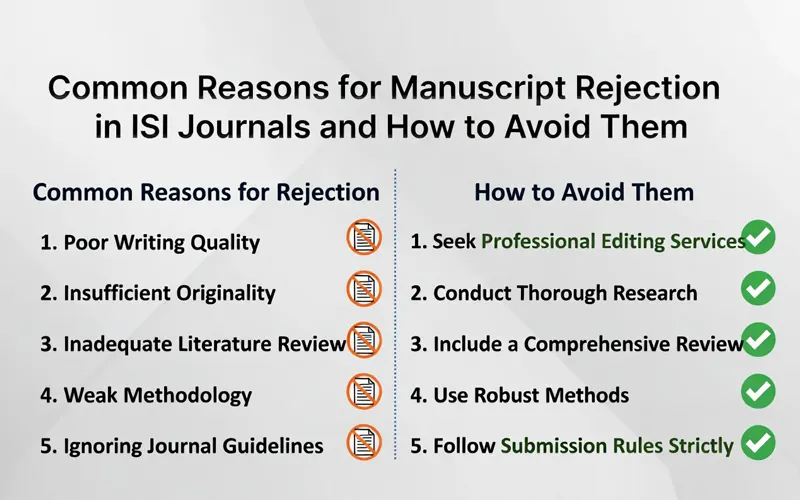
Introduction: Understanding Rejection to Achieve Success
Manuscript rejection is one of the most common challenges researchers face when submitting papers, articles, or manuscripts to ISI Web of Science journals. Understanding the reasons behind rejection is critical to increase acceptance rates, improve academic visibility, and ensure career advancement.
At TadbirSaz Institute, with 16+ years of experience and a dedicated team of 27 international experts, we have successfully guided over 8,000 publications to acceptance in SCI, SSCI, AHCI, ESCI, Scopus, and PubMed journals. Our guaranteed acceptance model is built upon deep understanding of editorial standards, bibliometrics, and reviewer expectations.
1. Scope Mismatch
- One of the leading causes of rejection is submitting to a journal whose scope does not align with your manuscript topic.
- TadbirSaz assists researchers in selecting journals where topics are trending, impactful, and aligned with editorial priorities, particularly in high-impact Q1 and Q2 journals.
2. Weak Research Design and Methodology
- Journals assess scientific rigor and reproducibility.
- Inadequate experimental design, statistical analysis, or methodology often leads to rejection.
- TadbirSaz provides advanced statistical consulting, experimental design review, and methodological optimization, ensuring manuscripts meet the highest scientific standards.
3. Poor Manuscript Structure and Writing
- Manuscripts may be rejected due to poor organization, unclear figures, or inconsistent formatting.
- Our team offers professional manuscript editing, English language polishing, and formatting aligned with publishers like Elsevier, Springer, Wiley, MDPI, Taylor & Francis, Nature Publishing, and IEEE.
4. Lack of Novelty or Original Contribution
- ISI journals prioritize original, innovative, and high-impact research.
- TadbirSaz ensures manuscripts highlight novelty, address gaps in current literature, and demonstrate scientific significance, increasing citations, Impact Factor relevance, and career visibility.
5. Ethical Concerns
- Issues such as plagiarism, data manipulation, or undeclared conflicts of interest lead to immediate rejection.
- We provide plagiarism checks, ethical guidelines support, and transparent author declarations, ensuring compliance with journal ethics and COPE standards.
6. Reviewer Feedback Mismanagement
- Ignoring or inadequately addressing reviewer comments often results in rejection.
- TadbirSaz offers strategic reviewer response management, including drafting polished rebuttals, clarifying methodology, and revising figures or analyses.
7. Bibliometric and Strategic Considerations
- Understanding journal metrics can prevent unintentional submission failures:
- Impact Factor (IF): Shows citations per paper over the previous two years.
- CiteScore and SJR: Evaluate Scopus-indexed journals.
- SiteScore: Measures journal quality and citation trends.
- h-index / g-index / Eigenfactor: Reflect journal and author influence.
- TadbirSaz helps authors select journals with optimal metrics, maximizing publication impact and citations.
8. How TadbirSaz Guarantees Success
- Expert Team: 27 international researchers with high h-index scores.
- Proven Results: Over 8,000 articles published in top-tier ISI, Scopus, and PubMed journals.
- Strategic Topic & Journal Alignment: We work with journals where we have repeated publication success.
- Comprehensive Manuscript Support: Writing, editing, methodology, submission, and reviewer response.
- Guaranteed Acceptance: 90% of fees charged after final acceptance, reflecting our confidence.
- Career and Academic Advancement: Enhances resume, citations, research funding opportunities, and professional recognition.
Conclusion
Rejection is part of the publishing journey, but understanding common causes and proactively addressing them can dramatically improve acceptance rates. TadbirSaz Institute provides end-to-end support, from journal selection and topic refinement to statistical analysis and reviewer management, ensuring your manuscript achieves high-impact publication and transforms your academic career and research visibility.