Introduction: Why Peer Review is Crucial
The peer review process is the backbone of scholarly publishing. Every paper, article, or manuscript submitted to ISI Web of Science journals undergoes rigorous evaluation to ensure scientific validity, originality, and relevance. Understanding this process is essential for researchers aiming for high-impact publications in Q1–Q2 journals.
At TadbirSaz Institute, we leverage over 16 years of experience and a team of 27 expert researchers to guide authors through peer review, from initial submission to final acceptance, ensuring ethical compliance and strategic positioning for maximum citations and visibility.
1. Types of Peer Review
Journals may implement different peer review models:
- Single-blind: Reviewers know the author’s identity, but authors don’t know the reviewers.
- Double-blind: Both authors and reviewers are anonymous.
- Open review: Reviewer and author identities are disclosed.
TadbirSaz helps researchers adapt manuscripts to the review model of each journal, including SCI, SSCI, AHCI, ESCI, and Scopus-indexed journals.
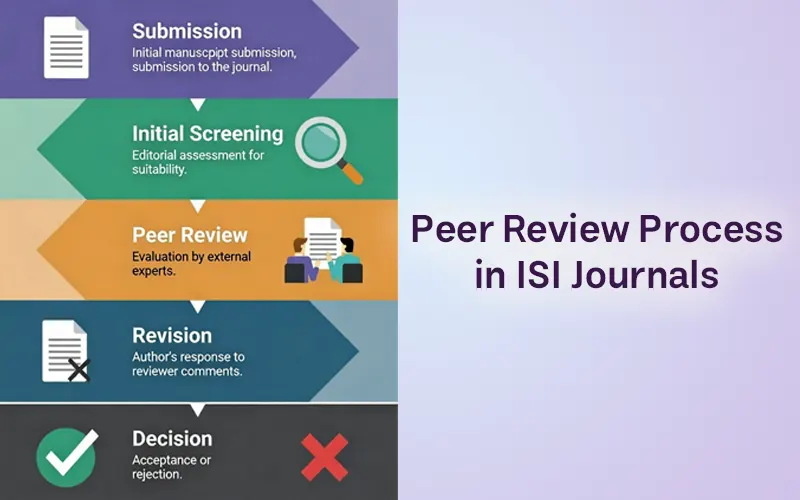
2. Stages of Peer Review
Understanding the workflow helps optimize acceptance chances:
- Initial Editorial Check: Editors assess scope fit, novelty, and formatting.
- Assignment to Reviewers: Experts in the field evaluate methodology, data analysis, and contribution.
- Reviewer Feedback: Comments may range from minor revisions to major rewrites.
- Final Decision: Acceptance, revision, or rejection based on scientific rigor and ethical compliance.
TadbirSaz supports authors at every stage, including strategic responses to reviewer comments, improving the probability of acceptance in journals published by Elsevier, Springer, Wiley, Taylor & Francis, MDPI, Nature Publishing, and IEEE.
3. Metrics Used to Evaluate Journals
Knowledge of bibliometric indicators informs strategic publication decisions:
- Impact Factor (IF): Measures citations per paper in the previous two years.
- CiteScore (Scopus): Average citations per document over three years.
- SJR (SCImago Journal Rank): Accounts for both number and prestige of citations.
- h-index / Eigenfactor: Measures author or journal influence in the scientific community.
- SiteScore: Scopus metric similar to IF, useful for assessing journal quality.
TadbirSaz guides authors in selecting journals with the highest likelihood of visibility and citations, targeting Q1 and Q2 journals for maximum career impact.
4. Common Challenges and How to Overcome Them
- Rejection due to scope mismatch: TadbirSaz selects journals aligned with your research topic.
- Reviewer misunderstandings: Our team helps clarify methodology, results, and significance.
- Formatting and ethical issues: Professional editing and plagiarism checks ensure compliance with ISI standards.
5. Why TadbirSaz Guarantees Acceptance
TadbirSaz’s guaranteed acceptance model is based on decades of experience and strategic planning:
- Expert Team: 27 researchers with h-index >20 and extensive publication records.
- Proven Track Record: Over 8,000 papers published in SCI, SSCI, AHCI, ESCI, Scopus, and PubMed journals.
- Targeted Journal Selection: Only journals where our team has repeatedly succeeded.
- Comprehensive Manuscript Support: Writing, editing, statistical analysis, and reviewer response management.
- Career Impact: Publications enhance resume, citations, academic visibility, funding, and promotion opportunities.
- Ethical and Strategic Approach: Guaranteed acceptance achieved without compromising research integrity.
Conclusion
The peer review process may seem challenging, but with TadbirSaz Institute, your manuscript, article, or paper is expertly guided through each stage. By understanding journal metrics, aligning with editors and reviewers, and leveraging our experienced international team, your research achieves high-impact publication, guaranteed acceptance, and maximum academic visibility.
With TadbirSaz, every submission is a step toward transforming your academic career and professional recognition.