Understanding ISI and Scopus
When it comes to publishing a research paper, article, or manuscript, researchers often face a critical question: Should I target an ISI Web of Science (WoS) journal or a Scopus-indexed journal? Both platforms are prestigious and widely recognized, but each has its characteristics and strategic advantages.
At TadbirSaz Institute, we help researchers navigate this choice by analyzing the journal’s scope, indexing, impact factor, and past acceptance patterns, ensuring that your manuscript is submitted where it has the highest chance of acceptance and online publication.
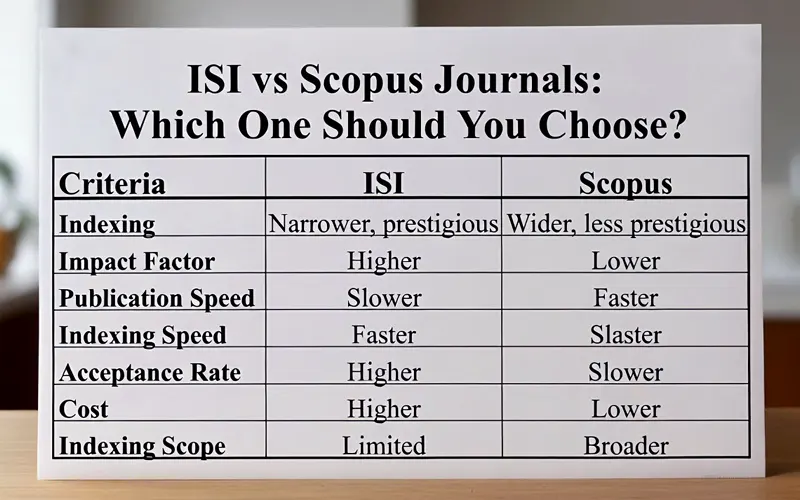
Key Differences Between ISI and Scopus
- Index Coverage
- ISI Web of Science (WoS): Covers SCI, SSCI, AHCI, and ESCI indexes, focusing on high-quality journals with stringent review processes.
- Scopus: Broader coverage across multiple disciplines, including more emerging journals, with a strong focus on citations and metrics.
- Journal Metrics and Quartiles
Both platforms categorize journals by quartiles (Q1–Q4), but ISI journals often carry Impact Factors (IF), which are critical for academic promotions, funding, and recognition. Scopus journals use CiteScore, SJR, and SNIP metrics, giving a complementary view of journal performance. - Acceptance Chances and Review Process
- ISI journals, especially Q1, are highly selective (~10–20% acceptance).
- Scopus journals may have a wider range of acceptance rates but maintaining high research quality and alignment with the journal’s scope is still critical.
Why Choose ISI or Scopus?
At TadbirSaz, we guide researchers in making a data-driven choice based on:
- Your research area: Some fields have stronger representation in ISI (e.g., natural sciences) and others in Scopus (e.g., engineering, applied sciences).
- Career goals: If your goal is academic promotion, tenure, or funding, ISI journals—particularly SCI or SSCI—may be preferred.
- Speed of publication: Scopus journals sometimes offer faster review cycles, which can be strategic for early-career researchers.
How TadbirSaz Optimizes Your Manuscript for ISI or Scopus
Our institute doesn’t just submit your manuscript blindly. We provide guaranteed acceptance plans using proprietary methods:
- Journal Mapping and Scope Matching
We only work with journals where TadbirSaz has repeatedly published papers successfully. Your manuscript topic is carefully aligned with the journal’s scope and editorial preferences. - Expert Collaboration
We involve internationally recognized researchers, many with h-index >50, to strengthen the quality, credibility, and novelty of your article. - Manuscript Enhancement
From language editing to structuring results and formatting references, every article or paper is enhanced to meet the highest standards of ISI and Scopus journals. - Strategic Submission and Follow-up
TadbirSaz manages the entire process—from submission to reviewer response and revisions—ensuring that your paper achieves guaranteed acceptance and online publication.
Factors Influencing ISI vs Scopus Choice
- Research novelty: ISI Q1 journals demand highly novel and impactful manuscripts.
- Citation expectations: Scopus journals value measurable citations and broad visibility.
- Target audience: ISI journals often have narrower but highly impactful readership, while Scopus journals may reach a wider, interdisciplinary audience.
- Previous success: TadbirSaz relies on our track record of successful publications in specific journals to guide your submission strategy.
Our Unique Guarantee Model
Although guaranteeing publication in top-tier journals may sound ambitious, TadbirSaz has perfected the process:
- Proprietary scientific and managerial techniques make acceptance achievable.
- Topics are defined according to journal interests and trending areas.
- Editorial boards and reviewer preferences are carefully considered.
- International experts with extensive publication records are involved in review and mentorship.
The result: a guaranteed acceptance plan, with 90% of the project fee payable only after final acceptance, reflecting our confidence in delivering results.
Conclusion
Choosing between ISI and Scopus journals is more than a preference—it is a strategic decision that can affect your career trajectory and research visibility.
With TadbirSaz Institute, your research is positioned to maximize impact, acceptance, and credibility. Our guaranteed plans, combined with decades of experience, careful topic alignment, and collaboration with top researchers, make the seemingly impossible task of publishing in high-impact ISI Q1 or Scopus Q1 journals a reality.